THE
MARKETS
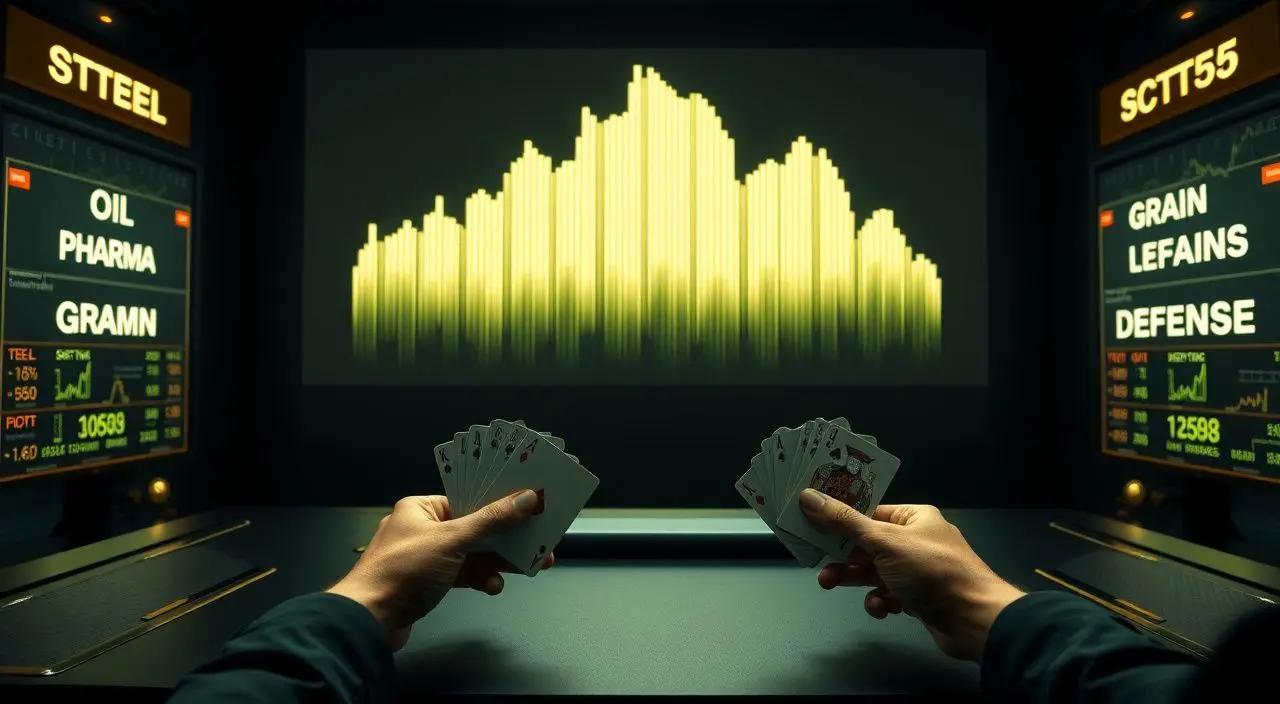
Six stocks. Hidden portfolios. Every card is a tell.
Every play that benefits you reveals what you hold. Every discard reveals what you DON'T need. The best traders learn to make their losing plays look like winning ones.
Players Required
The Roles
1 archetype
Trader
Each holds a secret portfolio: Long positions (gain on price up, multipliers up to ×3) and Short positions (gain on price down). Plays Market Events to push prices toward their portfolio while reading others' plays.
How a Round Plays
Portfolio deal
Each player secretly draws a portfolio card. Asymmetric: some hold 3 stocks (lower multipliers), some hold 2 (higher multipliers).
Draw 2 cards
Market Event deck has 60 cards: Supply Shock, Tech Boom, War Escalation, Regulation, Merger Rumor, Crash, etc.
Play 1, discard 1 face-up
Play one to manipulate prices. Discard one face-up — others read your discard for hints about your hand.
Resolve & advance
Stock prices update. 10 rounds total. Highest portfolio value wins.
Win Conditions
Highest portfolio
Sum of (final stock price × Long multiplier) − (final price × Short multiplier) after Round 10. Highest total wins.
Designer Notes
Cards have transparent effects but hidden owners. By Round 7 every player is doing three things at once: maximizing their portfolio, inferring others' portfolios from their plays, and playing cards that benefit them while LOOKING like they benefit someone else. Experienced players will play a deliberately suboptimal card just to misdirect. The discard is as much information as the play.
Strategy
- Discard high-value cards strategicallyA discard of a Tech Boom suggests you're NOT long TECH. Use it as misdirection — sometimes throw away a card you actually wanted to "prove" your portfolio.
- Watch the regulation patternRegulation freezes a stock for 2 rounds. Players regulate stocks they're NOT long. Track regulation targets to map portfolios.
- Crash is a nukeAll stocks -10. Useful when you're behind AND short on the leader's favorite. Cuts everyone but signals you're losing.
- Asymmetric portfolios shape strategyIf you have 2 stocks with x3 multipliers, you live and die by extremes. 3-stock players need balance — adjust your card play accordingly.
Ready to Play?
Pass-and-play offline with friends, or host an online room and play cross-device with anyone.
About Markets
Each player secretly holds a portfolio of stocks (Long / Short, with multipliers). 6 stocks on the board, all starting at 50. Each turn: draw 2 Market Event cards, play 1, discard 1 face-up. Card effects are public — the deception is in WHO plays WHAT and WHEN. The discard is information. So is the suboptimal play.
3-4 players (best with 4) · 30–45 min · Strategy-Heavy
How a round plays out
Portfolio deal
Each player secretly draws a portfolio card. Asymmetric: some hold 3 stocks (lower multipliers), some hold 2 (higher multipliers).
Draw 2 cards
Market Event deck has 60 cards: Supply Shock, Tech Boom, War Escalation, Regulation, Merger Rumor, Crash, etc.
Play 1, discard 1 face-up
Play one to manipulate prices. Discard one face-up — others read your discard for hints about your hand.
Resolve & advance
Stock prices update. 10 rounds total. Highest portfolio value wins.
Roles
- Trader(all)
- Each holds a secret portfolio: Long positions (gain on price up, multipliers up to ×3) and Short positions (gain on price down). Plays Market Events to push prices toward their portfolio while reading others' plays.
How to win
- Highest portfolio
- Sum of (final stock price × Long multiplier) − (final price × Short multiplier) after Round 10. Highest total wins.
Tips for new players
- Discard high-value cards strategically
- A discard of a Tech Boom suggests you're NOT long TECH. Use it as misdirection — sometimes throw away a card you actually wanted to "prove" your portfolio.
- Watch the regulation pattern
- Regulation freezes a stock for 2 rounds. Players regulate stocks they're NOT long. Track regulation targets to map portfolios.
- Crash is a nuke
- All stocks -10. Useful when you're behind AND short on the leader's favorite. Cuts everyone but signals you're losing.
- Asymmetric portfolios shape strategy
- If you have 2 stocks with x3 multipliers, you live and die by extremes. 3-stock players need balance — adjust your card play accordingly.
What makes it interesting
Cards have transparent effects but hidden owners. By Round 7 every player is doing three things at once: maximizing their portfolio, inferring others' portfolios from their plays, and playing cards that benefit them while LOOKING like they benefit someone else. Experienced players will play a deliberately suboptimal card just to misdirect. The discard is as much information as the play.
Every play that benefits you reveals what you hold. Every discard reveals what you DON'T need. The best traders learn to make their losing plays look like winning ones.
2-stock players are more volatile (bigger swings, harder to read). 3-stock players hedge more. Playtest shows roughly equal win rates with skilled players, slight 2-stock edge in 3-player.